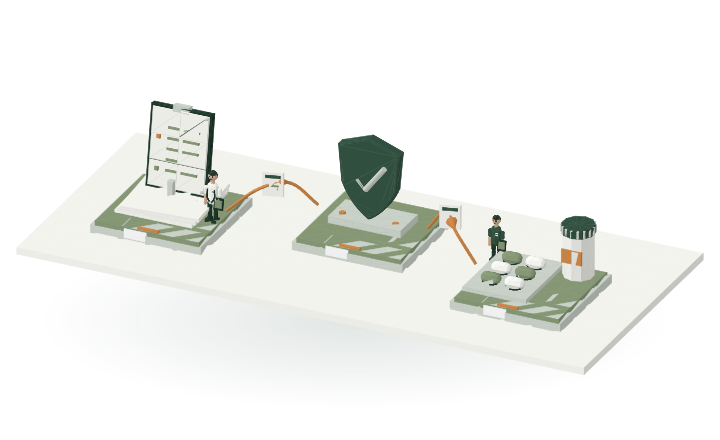
The 18 modules form the feature catalogue; they are not a mandatory selection. You decide which areas your institution uses. AI is activated only on request. Clinical dependencies and finalisation are described on the module pages.
01 / IN DAILY USE
Tasks and responsibility.
You choose this module according to your institution's needs. The interfaces described are configured for the areas you select. AI support is available exclusively on request and processes data on Oronela's own servers in Switzerland.
The module brings together medical orders, medication reconciliation, actual administrations, medicine stock and pharmacy orders. Each task has its own responsibility. An order is not yet a goods receipt, an available medicine is not yet a valid order, and a scheduled administration is not yet evidence of delivery.
On admission, return from hospital and changes, differences between sources are visibly compared. Product, strength, dose, unit, route of administration and schedule remain unambiguous. The billing connection accepts confirmed sources only, including a required indication code in the applicable medication profile.
Information maintained by the module
Area
Content and meaning
Order revision
Prescriber, source, medicine or intervention, dosage, period, approval and the meaning of the signature.
Administration event
Actual administration, non-administration, refusal, as-needed criteria, checks and documented effect.
Medication movement
Resident reference, product, batch, quantity, storage location and documented receipt, consumption or correction.
02 / MODULE FUNCTIONAL SCOPE
What this module covers.
5 functional areas connect this module's tasks. The following sections explain their content, processing and responsibilities.
01
Clinical orders, revisions and approvals
Record structured orders once and use the same confirmed source in care, appointments and nutrition.
Record an order with its originator, actual issuer, competence, source, validity period, status, clinical meaning and specific approval; distinguish between the documenting person and the prescriber.
A medication prescription requires the medicine or active substance, strength, dose, unit, administration route, schedule, start and end, and required as-needed criteria. Incomplete or contradictory information remains non-executable.
A general preparation order contains explicit restrictions, a validity window, exceptions and the responsible professional. Fasting must not be inferred solely from the time, appointment type or AI inference.
Approval binds the exact data revision, identity, competence status and meaning of approval. Subsequent changes invalidate the previous execution approval for the changed content.
Configure the required signature type for each action with versioning; do not present a simple login confirmation as a qualified signature. An externally signed source is retained as an unaltered supporting document.
Interruptions, stopping and corrections must inform outstanding administrations; confirmed historical administration remains referenced to the order valid at the time.
Responsibility
Doctors prescribe within a valid care relationship and their competence; nursing staff record permitted external orders with documented provenance. Signature and second-person check rules apply to each procedure; technical administration does not gain clinical authority.
Automation & AI
AI may structure incoming texts, flag incomplete information and draft queries. It cannot autonomously prescribe, determine doses, change treatment or approve timing. AI features require activation at your request. Processing remains on Oronela's own servers in Switzerland.
Connection & offline use
Local drafts are possible; every binding order approval, pause or resumption and decision on whether an order may be carried out requires an online connection. The cache can explicitly become outdated and does not provide authorisation.
02
Medication reconciliation, allergies and approved plausibility checks
Bring together conflicting lists and safety information visibly before use and avoid maintaining the same facts twice.
Admission, return from hospital and prescription changes open a traceable reconciliation case with all source lists, import time, validity and the confirmed current list.
Show differences in active ingredient, strength, dose, unit, route, schedule and status at field level; a missing entry is neither automatically discontinued nor confirmed unchanged.
Maintain structured allergy and intolerance records with type, severity or information status, source, confirmation, valid revision and differentiated visibility. Strictly distinguish unknown, negative and positive findings.
Connect approved interaction and plausibility data with licence, version and validity. An outdated or unavailable catalogue creates an explicit state and the clinically approved fallback route.
Importing a list does not change an active prescription; changes require M03-A and new approval. Handling warnings with a reasoned override based on role and risk is permitted only where clinically authorised.
Safety rules are deterministic and traceable; intended use, risk controls and professional approval must be evidenced before production operation. An LLM response cannot serve as a verified interaction finding.
Responsibility
Authorised doctors and care professionals perform reconciliation appropriate to their competence; the pharmacy provides sources or queries rather than overwriting plans without control; the kitchen role receives only relevant dietary restrictions.
Automation & AI
AI helps extract and explain list differences with sources. It decides neither discontinuation nor dosage, confirms no absence of allergies and suppresses no rule-based finding. AI features require activation at your request. Processing remains on Oronela's own servers in Switzerland.
Connection & offline use
Record a source draft and read permitted stock information; reconciliation confirmation, allergy approval and current safety decisions require an online connection. Outdated safety information is clearly visible.
03
Medication administration and stock impact
Document safe administration to the resident and traceably connect prescription and order statuses so that repeats and missing responses become apparent.
Keep intended administration, actual administration, non-administration, refusal, as-needed administration, effect and any second check as separate clinical evidence. As-needed administration is linked to confirmed criteria and checked time limits.
Before binding digital administration, check the current resident identity, executable order revision, competence, allergy and review status and any existing administration events on the server.
Prevent duplicate administration using the clinical administration event, including across two devices with different technical idempotency keys. Offline time or scanner identification must not bypass this check.
The second check must be bound to the specific administration preparation and revision; changes require another check. Refusal or non-administration generates a clinically approved escalation process where necessary.
Link administration and actual consumption through the M03-D stock port in the same M03 transaction; the clinical administration slot and movement reference prevent duplicate posting. Non-administration, a prepared dose, loss and return each have their own clinical meaning and do not create a fictitious administration.
Show prescription and pharmacy status only as an authorised current projection from M03-E. Technical confirmation is neither physical goods receipt nor availability. If stock differs, the actual action remains identifiable; the approved exception or retrospective entry process requires clarification.
A later record of a real emergency action remains identifiable as such and is clinically reviewed; it does not claim that online approval occurred retrospectively.
Responsibility
Competent nursing staff and doctors act according to each action; independent second checks follow the approved rule; pharmacies see only their own order and delivery scope. Ordering and medication have separate permissions.
Automation & AI
AI may summarise missing order responses and structure observed effect notes as drafts. It does not approve medication, calculate a new dose or confirm receipt. AI features require activation at your request. Processing remains on Oronela's own servers in Switzerland.
Connection & offline use
Binding digital medication administration, including a second check, requires an online connection. Offline access is limited to an authorised view clearly marked as potentially outdated and a documented emergency or retrospective entry draft; a clinically approved fallback process operates outside digital approval.
04
Medicine stock, batches and stock movements
From checked goods receipt to actual use, all medication stock remains linked to its provenance and owner.
Medication is managed by resident or owner, location, storage compartment, product, unit, batch and expiry date. Resident-specific and shared stock remain distinguishable. Similar product names or active ingredients do not justify withdrawing from another stock allocation.
Receipt, reservation, preparation, removal, administration, return, loss, destruction and stocktake corrections each have their own meaning. Available stock results from these movements and their evidence. A documentation correction therefore does not claim the physical return of a tablet that has already been used.
Expiry date, opening, quarantine, recall and confirmed storage deviations affect usability. Restricted batches are not reserved or issued in the regular workflow. A clinically permissible release requires the corresponding permission and traceable evidence.
Partial packs and unit conversions follow approved product rules. Two simultaneous withdrawals of the last available quantity must not create duplicate availability. Stock counts and later corrections retain the time, person, reason and reference to the original movement.
Evidence of actual administration from M03-C is linked to exactly one matching consumption movement. Technical retries do not post the same administration again. Differences between documented and physical stock remain visible as clarification cases. Supplies and kitchen ingredients are managed separately in M10.
Responsibility
Authorised care and medication managers manage stock and movements. Stocktaking, destruction and release of quarantined goods have separate permissions.
Automation & AI
Stock rules identify shortages and affected recalls. AI can structure evidence, but confirms neither goods receipt nor medicine release. AI features require activation at your request. Processing remains on Oronela's own servers in Switzerland.
Connection & offline use
Count notes may be prepared as drafts under the approved device profile. Binding reservations and stock movements require a current server check.
05
Prescriptions, pharmacy orders and replenishment
Replenishment connects the valid medication plan with available quantities, open orders and actual goods receipt.
The needs calculation considers valid orders, available and reserved quantities, expected supply, lead time and an approved buffer. As-needed medication is not assumed to be definite daily consumption. Absences, stopped prescriptions and already outstanding partial orders are included in the review.
The worklist shows how long stock is expected to last, which foundations are missing and who must decide. A reorder suggestion is not a new prescription. Before transmission, ordering authority, any required medical signature, budget and the specific pharmacy profile are checked.
Draft, approved order, transmission, uncertain outcome, acceptance, rejection, partial and full delivery, and clinical reconciliation are separate states. A delivery notification does not increase available stock. Only a checked goods receipt triggers a movement in the medication inventory.
Incorrect deliveries, differing products, batches or resident assignments create a case for handling. Substitution or dose changes go to the responsible professional. Rule-based repeat orders are allowed only within an explicitly approved scope and while the underlying information remains valid.
Cancellations take into account that delivery may already have occurred. If no response is received after transmission, the outcome is reconciled. A new order is not triggered solely because technical confirmation is missing.
Responsibility
Care staff and authorised ordering managers prepare replenishment; medical and pharmaceutical decisions remain with the responsible specialists.
Automation & AI
AI can convert delivery notes and responses into reviewable drafts or explain a shortage. Substitute medication and physical receipt require confirmation by a responsible person. AI features require activation at your request. Processing remains on Oronela's own servers in Switzerland.
Connection & offline use
Definitive orders and approvals take place online. The documented outage procedure remains visible when the pharmacy is disconnected.
03 / ADDITIONAL FEATURES
Further features in detail.
Indication codes from confirmed medication sources
For relevant medications with a pricing or reimbursement model, billing takes a professionally confirmed indication code from the order and approved, dated medication data. The link between medication, indication, source and order revision is preserved. AI does not infer a missing code from an assumed diagnosis.
The specific medicine profile determines when a code is required. A medicine that is not affected is not assigned an invented mandatory field. A missing or inconsistent source reference opens a query to the responsible specialist. Deadlines and checks of funding bodies are explained in the “Swiss billing 2027” section of M11.
04 / PRACTICAL EXAMPLE
Changed prescription with an open replenishment order
01
A professional confirms the new order revision.
02
Outstanding administrations and previously calculated replenishment are checked for validity.
03
The responsible department clarifies a pharmacy order already transmitted and any partial delivery.
04
Checked goods receipt and subsequent actual administration are documented separately.
The medication plan, physical stock and partner status remain traceable together. A delivery notification or old order proposal does not confirm substitute medication.
SYSTEM WORKFLOW / Typical workflow
Typical workflow
01
A medical order is assigned a resident reference, validity and clinical responsibility.
02
Authorised professionals check approval and the relevant allergy and stock context.
03
Actual administration or reasoned non-administration is documented as its own record.
View the domain workflow in 3D +
M03 / WORKFLOWCare · Doctor
Medical orderBeing transferred
Illustrative workflow model
01Record an order
→
INFORMATIONMedical order
→
02Approve & reconcile
Product · Dose · ValidityReady for handover
A medical order is assigned a resident reference, validity and clinical responsibility.
An approved order governs actual administration and its evidence.What information is passed on?
01 → 02
Medical order
Product · Dose · Validity
02 → 03
Approved administration order
Resident reference · Reconciliation · Approval
DATA EXCHANGE / MODULE CONNECTIONS
Interfaces in context.
M03 is at the centre. The connections show which modules can provide or receive information when selected and configured for your institution. Choose a connection to see its data scope.
M03 / CONNECTIONSExchange across modules
Resident identityBeing transferred
Versioned module contracts
M01Identity & stay
→
INFORMATIONResident identity
→
M03This module
Resident context and stay valid at the relevant time.Ready for handover
Resident context and stay valid at the relevant time. Each administration must be assigned to the verified identity.
The connections show domain data relationships. Specific API contracts and partner connections are versioned and approved separately.
Prescription, pharmacy order and approved responses.
Professional rule
The partner contract, mapping and acknowledgement are evidenced separately.
The module requirements define the exchange of domain information. Each module manages its own data; other modules use approved, versioned contracts. Permissions, tenant, revision and acknowledgement are preserved throughout.
This module, selectable according to need, is part of Oronela in finalisation. Functions, responsibilities and interfaces form the fixed scope. Finalisation combines professional acceptance reviews with feedback from care institutions: real needs determine the final improvements.
Cross-checked against the module requirements, implementation specification and current Oronela system codebase: 1 October 2026. Product requirements M03-01–M03-06 · M03-A–E. The following areas are explained on this page: