The 18 modules form the feature catalogue; they are not a mandatory selection. You decide which areas your institution uses. AI is activated only on request. Clinical dependencies and finalisation are described on the module pages.
01 / IN DAILY USE
Tasks and responsibility.
You choose this module according to your institution's needs. The interfaces described are configured for the areas you select. AI support is available exclusively on request and processes data on Oronela's own servers in Switzerland.
Quality management links incidents, complaints and suggestions for improvement to responsibility and specific actions. A report is captured once, triaged with protection and routed to the appropriate department. Necessary immediate action remains separate from a confidential investigation.
A case ends with a reasoned review of its effectiveness. Root-cause analysis, correction, prevention and evidence remain visible together. Quality reports use approved definitions and frozen data versions so that an indicator can still be explained after a later case correction.
Information maintained by the module
Area
Content and meaning
Quality case
Incident, time, report, triage, protection needs, responsibility and required immediate measures.
Action and review
Cause reference, deadline, completion, evidence, effectiveness criterion and responsible assessment.
Quality report
Definition, included data status, calculation, limitation, approval and permitted external transfer.
02 / MODULE FUNCTIONAL SCOPE
What this module covers.
3 functional areas connect this module's tasks. The following sections explain their content, processing and responsibilities.
01
Incident reporting, complaints and protected triage
Record incidents once and automatically route them to the responsible people; separate necessary immediate measures from confidential investigation.
Falls, medication deviations, critical incidents, complaints and improvements have a classified type, incident and entry time, facts, optional resident or staff reference, reporter and urgency.
Immediate help and clinical care remain in the professional process; a quality report must not imply that treatment has already occurred or make urgent care wait for an AI run.
Versioned rules assign responsible parties, substitutes, processing deadlines and required initial assessment. Cases that cannot be assigned appear visibly in a monitored clarification queue.
Confidentiality levels and personnel references have separate access groups. The unit view receives only necessary measures; reporters' identities must not leak through exports, search results or notifications.
The permitted reporting channel must transparently explain whether it is confidential, pseudonymous or genuinely anonymous; personal references in the text and technical audit data prevent an unfounded promise of anonymity.
Responsibility
Employees report, authorised quality management teams triage, and confidential staff references remain within the defined group. Ward management sees approved safety actions, not automatically the investigation.
Automation & AI
Rules route and escalate; private AI can structure free text and suggest duplicates. It decides neither blame, personnel consequences nor the classification that closes a case. AI features require activation at your request. Processing remains on Oronela's own servers in Switzerland.
02
Causes, actions and effectiveness
Track improvement steps with accountability and close cases only after an evidenced effectiveness review.
Investigations separate facts, open questions, hypotheses, sources and conclusions. Each step has responsible people and appropriate permissions.
Corrective and preventive actions have a goal, executing department, deadline, evidence, effectiveness criterion and review date. A checked-off task is not confirmation of effectiveness.
Severity and case profiles define the necessary independent review and authority to close. Professional or clinical orders are executed through the responsible modules, not changed through quality management text.
Ineffective or delayed interventions lead to reassessment or escalation. Reopening preserves the original closure with its reasons.
Disclosure of an action removes confidential investigation details in a controlled manner; copied free text must not bypass the protected group.
Responsibility
Quality management coordinates, responsible employees carry out actions and authorised reviewers assess effectiveness; necessary separation of duties must not disappear even through combined roles.
Automation & AI
Reminders, deadlines and missing evidence follow rules. AI may offer evidence-based summaries and intervention drafts; a human confirms the judgement of cause, intervention and effectiveness. AI features require activation at your request. Processing remains on Oronela's own servers in Switzerland.
03
Quality definitions and controlled reporting
Generate reproducible quality reports from existing evidence and quickly answer questions about provenance or calculation.
Indicator and reporting profiles contain the definition, numerator and denominator, inclusion and exclusion rules, period, sources, data quality rules, destination channel and versioned approval.
Report runs freeze the data version and rule version used. Later corrections create a new report revision rather than changing the approved historical result.
Missing data, small groups and limited evidential value are visible; missing values are not silently treated as zero or faultless quality.
Required reports are submitted only through genuinely approved current profiles and responsible people. The system does not claim blanket legal compliance across all locations.
Exports and drill-downs respect original permissions and confidential sections; aggregated quality data does not authorise access to every individual case.
Responsibility
Quality management maintains profiles, the responsible professional department approves reporting, management receives authorised indicators and auditors only permitted evidence.
Automation & AI
Scheduled calculations and completeness checks; AI explains deviations as hypotheses with sources. Reporting, indicator definitions and external disclosure remain actions requiring approval. AI features require activation at your request. Processing remains on Oronela's own servers in Switzerland.
03 / PRACTICAL EXAMPLE
A deviation becomes a verified improvement
01
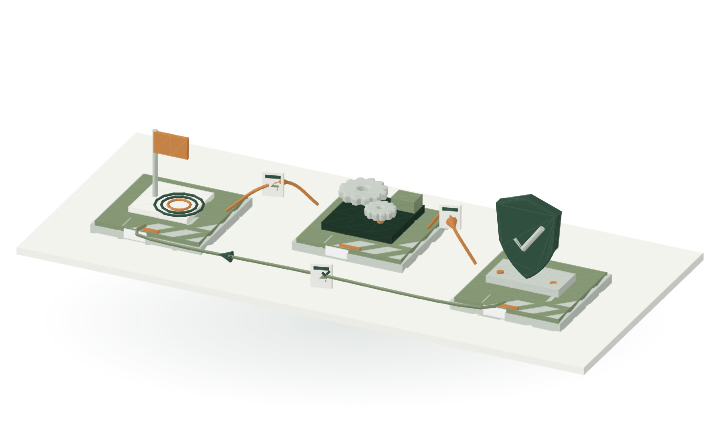
An employee reports the observed deviation.
02
Quality management defines responsibility, the protected area and necessary immediate actions.
03
The responsible party documents the cause and carries out the confirmed intervention.
04
An authorised review checks effectiveness; insufficient effectiveness leads to further handling.
A completion checkbox or AI summary does not close the case on its own. Confidential staff details remain with the group authorised to see them.
SYSTEM WORKFLOW / Typical workflow
Typical workflow
01
An incident or complaint is recorded with responsibility and protection needs.
02
Causes, interventions, deadlines and execution are professionally assessed and updated.
03
Only a documented effectiveness review permits professional closure.
View the domain workflow in 3D +
M13 / WORKFLOWStep by step
Incident reportBeing transferred
Illustrative workflow model
01Report an incident
→
INFORMATIONIncident report
→
02Implement interventions
Case · Protection needs · ResponsibilityReady for handover
An incident or complaint is recorded with responsibility and protection needs.
Actions and an effectiveness review turn a report into a completed quality case.What information is passed on?
01 → 02
Incident report
Case · Protection needs · Responsibility
02 → 03
Intervention evidence
Cause · Implementation · Deadline
03 → 01
Effectiveness assessment
Review · Effect · Case closure
DATA EXCHANGE / MODULE CONNECTIONS
Interfaces in context.
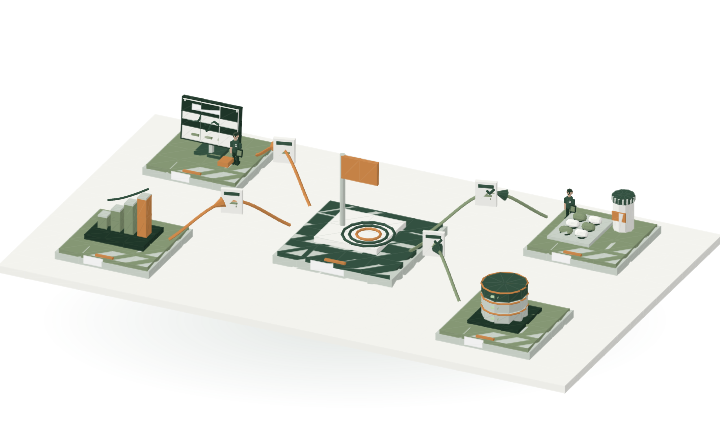
M13 is at the centre. The connections show which modules can provide or receive information when they have been selected and configured for your institution. Select a connection to view the data it covers.
M13 / CONNECTIONSExchange across modules
Care incidentBeing transferred
Versioned module contracts
M02Care incident
→
INFORMATIONCare incident
→
M13This module
Approved incident context and affected care delivery.Ready for handover
Approved incident context and affected care delivery. Confidential cases retain their own access group.
The connections show domain data relationships. Specific API contracts and partner connections are versioned and approved separately.
The quality case remains reconstructable through its history.
The module requirements define the exchange of domain information. Each module manages its own data; other modules use approved, versioned contracts. Permissions, tenant, revision and acknowledgement are preserved throughout.
This module, selectable according to need, is part of Oronela in finalisation. Functions, responsibilities and interfaces form the fixed scope. Finalisation combines professional acceptance reviews with feedback from care institutions: real needs determine the final improvements.
Comparison with the module requirements, implementation plan and current Oronela system codebase: 1 October 2026. Product requirements M13-01–M13-04 · M13-A–C. The following areas are explained on this page: