The 18 modules form the feature catalogue; they are not a mandatory selection. You decide which areas your institution uses. AI is activated only on request. Clinical dependencies and finalisation are described on the module pages.
01 / IN DAILY USE
Tasks and responsibility.
You choose this module according to your institution's needs. The interfaces described are configured for the areas you select. AI support is available exclusively on request and processes data on Oronela's own servers in Switzerland.
Organisation and permissions connect the customer account, locations, units, teams and personal access. The institution defines responsibilities and suitable roles from a versioned action catalogue. Assignments apply to a specific scope, purpose and period.
An appropriate role alone is not enough for a professional action. Competence, the relationship to a resident or task and the current context are also checked. Joining, changes, representation and leaving control access systematically. Personal language and workspace layout remain separate from these professional permissions.
Information maintained by the module
Area
Content and meaning
Organisation revision
Customer account, location, unit, team, responsibility and structural changes over time.
Role and assignment
Permitted actions, area, purpose, validity, responsible approval and required competence reference.
Personal profile
Language, interaction preferences, workspace layout and permitted self-service channels.
02 / MODULE FUNCTIONAL SCOPE
What this module covers.
3 functional areas connect this module's tasks. The following sections explain their content, processing and responsibilities.
01
Organisation, teams and personal settings
Configure institutions and responsibilities reliably once; each person works with their own language and interaction settings.
Tenant, location, unit, team and responsible function have separate identities, validity periods and explicit relationships; membership of a location does not automatically grant cross-tenant reading permission.
Opening, reorganisation and closure check existing stays, shifts, resources and permission assignments; referenced units are ended, not deleted from history.
Each user has a preferred supported language, additional language preferences, time zone and display options and permitted notification settings. A site default is only an initial value; language is not rigidly enforced based on role or nationality.
Language and profile changes are versioned across devices. Missing translations follow the documented fallback rule without silently changing clinically relevant meanings.
Tenant provisioning uses approved foundation workflows for a dedicated database, credentials and key scopes. The UI shows success only after a complete response; partial provisioning remains blocked and subject to clarification.
Responsibility
Organisation administration manages structure within its own scope, users their own preferences; the platform operator carries out approved provisioning without professional record access.
Automation & AI
Templates and deterministic completeness checks simplify setup. AI may structure organisation descriptions into drafts; tenant creation, responsibility and permissions are explicitly approved. AI features require activation at your request. Processing remains on Oronela's own servers in Switzerland.
02
Custom roles, competence and approved assignment
Configure roles to suit the institution without having to maintain complex permissions manually in each module.
A versioned action catalogue contains stable codes, resources, conditions, purpose, competence requirements, risk class and permitted delegation. Translated role names are not permission logic.
Custom roles can combine only offered, approved actions; tenant, site or ward, relationship, purpose, time and competence conditions are not replaced by hiding elements in the UI.
Draft roles and active revisions are separate; dangerous extensions require defined independent approval, display of the impact on affected assignments and policy checks.
M06-A is the authoritative owner of employee competences and their evidence and validity periods. M15 references this approved evidence through the policy port and checks its current validity and responsibility; it neither stores nor approves a second employee competence record. The responsible specialist teams confirm the treatment relationship and scope of delegable permissions. Technical administrators cannot grant themselves authority to prescribe medication.
For external doctors and professionals without an employment relationship, M15 explicitly owns an ExternalProfessionalCredential with issuer, namespace, external reference, evidence revision, validity and an authorised verification decision. Linking to a later employee identity requires verified assignment and a single authoritative competence record; no automatic duplicate is created.
Assignments have a start, end, reason and approving department; short-term representation is not permanent copying of all permissions. Effective permissions can be explained for a specific context without reading restricted data.
Responsibility
Organisation administrators operate within the delegable framework; security and professional approvers are separate; competence is confirmed only by an authorised department; auditors read permitted assignment evidence.
Automation & AI
Templates, expiry warnings and comparison of target and actual states. AI can draft a clear role description from permitted actions; role changes, approval and competence evidence remain deterministic authorised commands. AI features require activation at your request. Processing remains on Oronela's own servers in Switzerland.
03
Joining, changes, leaving and regular reviews
Grant permissions along the actual employee lifecycle and fully revoke them in good time.
Joining, a change of role, representation, extended absence and leaving are versioned processes with source, effective time, responsible people, necessary approvals and verifiable completion.
Account activation, roles and teams, devices, sessions, API and service access and active real-time channels are coordinated with the foundation services; missing partial confirmations remain visible and are escalated.
Online access becomes invalid after revocation within the existing maximum period of 60 seconds; offline leases remain explicitly limited to four hours at most, and critical actions require an online check regardless.
Role changes revoke old permissions specifically. Periodic recertification checks current necessity, expiry and competence; an unanswered review leads to the approved safe process.
Personal employee self-service for one's own leave and preferences in M06 is a narrowly defined capability, not general access to HR data or duty rosters at other sites.
Individual language and accessibility preferences remain consistent during permitted internal changes; retention and deletion on leaving follow the approved data approach, not blanket deletion of historical authorship.
Responsibility
HR initiates within its scope, management and professional leads confirm the need, and identity administration handles faults; exit approval must not grant medical authority.
Automation & AI
Deadlines, provisioning and revocation sequences, and recertifications run automatically in a controlled way; AI may summarise outstanding points. It decides neither hiring or dismissal nor competence grants. AI features require activation at your request. Processing remains on Oronela's own servers in Switzerland.
03 / ADDITIONAL FEATURES
Further features in detail.
Personal workspace, multiple windows and language
The browser workspace supports multiple professional windows: for example, resident record, duty roster, document and personal assistance side by side. Windows can be freely arranged or placed in suitable areas. The personal layout is separate from the organisation and role model.
Each window binds its visible resident or domain context. A late AI response, dictation or form draft must not enter the record of a different person opened in the meantime. Context changes and closing protect drafts not yet accepted according to the approved device profile.
The user interface language, the resident’s communication language and the language of a contract or external message format are recorded separately. Changing language does not alter permissions, codes, quantities or signed originals. The website and complete user documentation are available in German, French, Italian, Romansh and English.
04 / PRACTICAL EXAMPLE
An employee moves to another site
01
The responsible department confirms the new role and its validity start.
02
Roles, deployment scope and required competences are checked for the destination location.
03
Old and new access rights are adjusted through a traceable transition plan.
04
Active sessions and real-time views adopt the current permission state.
The new site assignment does not open blanket access to the full record. Historical responsibilities remain reconstructable, while future actions check current permissions.
SYSTEM WORKFLOW / Typical workflow
Typical workflow
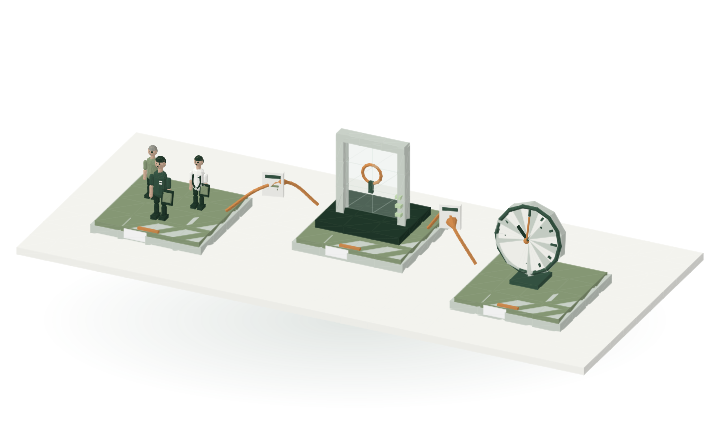
01
Organisational scope, role and professional competence define the intended access.
02
The assignment is professionally reviewed, approved and granted with temporal validity.
03
Time limits, role changes and leaving change or revoke access in the web interface, app and API too.
View the domain workflow in 3D +
M15 / WORKFLOWResident · Care · Doctor
Access assignmentBeing transferred
Illustrative workflow model
01Role & context
→
INFORMATIONAccess assignment
→
02Approve assignment
Role · Competence · ScopeReady for handover
Organisational scope, role and professional competence define the intended access.
Organisational context and professional competence limit the valid access assignment.What information is passed on?
01 → 02
Access assignment
Role · Competence · Scope
02 → 03
Approved permission
Approval · Time limit · Revocation
DATA EXCHANGE / MODULE CONNECTIONS
Interfaces in context.
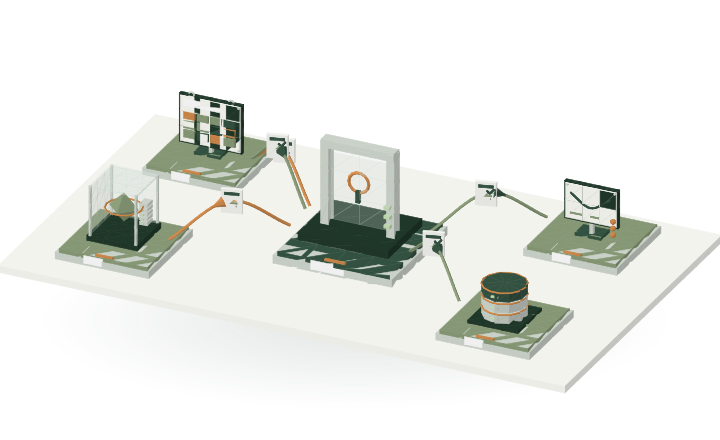
M15 is at the centre. The connections show which modules can provide or receive information when they have been selected and configured for your institution. Select a connection to view the data it covers.
M15 / CONNECTIONSExchange across modules
Role & competenceBeing transferred
Versioned module contracts
M15This module
→
INFORMATIONRole & competence
→
M06Employee context
Joining, role, team and competence.Ready for handover
Joining, role, team and competence. Access depends on the current context as well as the role.
The connections show domain data relationships. Specific API contracts and partner connections are versioned and approved separately.
Assignment, approval, revocation and support access.
Professional rule
Temporal validity and reasoned approval remain verifiable.
The module requirements define the exchange of domain information. Each module manages its own data; other modules use approved, versioned contracts. Permissions, tenant, revision and acknowledgement are preserved throughout.
This module, selectable according to need, is part of Oronela in finalisation. Functions, responsibilities and interfaces form the fixed scope. Finalisation combines professional acceptance reviews with feedback from care institutions: real needs determine the final improvements.
Comparison with the module requirements, implementation plan and current Oronela system codebase: 1 October 2026. Product requirements M15-01–M15-04 · M15-A–C. The following areas are explained on this page: