The 18 modules form the feature catalogue; they are not a mandatory selection. You decide which areas your institution uses. AI is activated only on request. Clinical dependencies and finalisation are described on the module pages.
01 / IN DAILY USE
Tasks and responsibility.
You choose this module according to your institution's needs. The interfaces described are configured for the areas you select. AI support is available exclusively on request and processes data on Oronela's own servers in Switzerland.
Integration connects domain modules with external partners through verified contracts. HIN, EPD, FHIR, medication data, pharmacies, funding bodies, financial systems and payroll systems fulfil different tasks. Signature services, mail transport and commissioned postal dispatch are also included.
For each connection used in production, the counterpart, schema, mapping, access, recipients and error handling are defined. Technical transmission and professional acceptance remain separate. Provenance and the precise content revision stay connected through retries, delayed responses and system changes.
Information maintained by the module
Area
Content and meaning
Partner and mapping profile
Counterparty, contract version, identifiers, schema, field mapping, channel and permitted content.
Transmission transaction
Source revision, stable identity, attempts, technical acknowledgement, uncertain outcome and responsible error handling.
6 functional areas connect this module's tasks. The following sections explain the content, handling and responsibilities.
01
API catalogue, mapping and delivery monitoring
A consistent integration pattern prevents repeated one-off solutions and makes errors reliably actionable.
Versioned REST, FHIR and event contracts document purpose, schema, permitted operations, error codes, versioning and deprecation, paging or cursors and permission context. External clients do not receive direct database access.
For each partner, the source and target systems, issuer namespace, external IDs, profile and mapping revision, delivery semantics, ordering and idempotency strategy are registered; external IDs are not used as internal primary keys.
Incoming data is checked for schema, size and permissions and transferred to a traceable inbox; domain processing uses authorised commands with provenance instead of direct table-writing permissions.
Technical delivery, professional acceptance, rejection and unknown outcome are separate. Retries and backoff, duplicates, late messages, dead letters and manual resumption are bounded and auditable.
Connector status shows configured, tested, professionally accepted, active or disrupted; an unconnected partner never appears as successfully synchronised.
Responsibility
Integration administrators configure narrowly scoped service accounts, professional leads decide on domain-related rejections, and operators see technical metadata without blanket payload access.
Automation & AI
Classify technical errors and retry under rules. AI may explain authorised error messages or produce mapping drafts; profile approval and uncertain assignments remain human-confirmed. AI features require activation at your request. Processing remains on Oronela's own servers in Switzerland.
02
Medical partners, secure communication and identifiers
Connect medical communication, document exchange, medicine data and pharmacy processes without retyping information.
Connection profiles for HIN and secure communication, EPD, medicine data, pharmacy and relevant professional identifiers are defined separately. Counterparties actually commissioned have specific contracts, test cases, operational contacts and acceptance.
Each profile must define transport and authentication, required standards, permissions and consents or another valid approval basis, namespaces, document and message types, acknowledgements and fault procedures; the unverified assumption ‘EPD = any FHIR’ is not accepted.
Medication, interaction and master data require permitted use, a version, currency checks and clinical approval of the intended purpose. A language model does not replace a licensed or qualified medication source.
Person and provider assignment validates the issuer and context; uncertain assignment leads to a secure clarification process, never silent merging of residents.
Received prescriptions, documents and technical acknowledgements are correctly handed to M03/M12; an external message is not automatically treated as an internally approved clinical order.
Each adapter family receives an isolated subdirectory and its own fixtures within the chunk path; partner tasks assigned in parallel require explicit ownership. Independent tests must not use other parties' live patient data.
Responsibility
Narrowly authorised integration accounts, professionals for identity and order verification, and defined communication approvers. Technical configuration is not permission to publish all documents externally.
Automation & AI
Automatic assignment follows only approved unambiguous rules; AI can structure protected incoming content into drafts. Ambiguous identity, clinical acceptance and external approval remain explicitly checked. AI features require activation at your request. Processing remains on Oronela's own servers in Switzerland.
03
Funding and finance partners and complete portability
Automate operational handovers under control and enable a genuinely usable change of provider or system.
Separate adapter profiles cover insurers and funding bodies, financial accounting and payroll; appointed partners require specific formats, period and currency rules, checksums, acknowledgements and professionally approved reference cases.
M11 supplies approved invoice and service data, M06 approved time and allowance foundations. M17 transports and checks mappings, calculates neither the general ledger nor payroll, and does not interpret technical acceptance as payment.
A portability package contains machine-readable professional objects, original documents, revisions and relationships, external ID namespaces, time, language and unit context, permission and provenance context and interpretable schema versions.
The key and decryption route, recipient identity, secure handover, retention and permitted scope are approved before export. Portability is not feigned by uselessly handing out ciphertext that cannot be decrypted; system-wide master keys are not handed out wholesale.
An export creates a consistent snapshot with a manifest, hashes and evidence of completeness. An import dry run in an isolated target environment checks integrity, relationships and permission assumptions; changing provider requires an approved cutover and delta workflow.
Partner tasks and the portability profile receive separate subdirectories and fixtures and specific owners; outstanding partner access prevents their production release without blocking the contract draft.
Responsibility
Finance and staff administration are strictly separated by payload; data protection and data owners approve the scope, recipients are authenticated personally or as a service; support receives no blanket export right.
Automation & AI
Scheduled approved handovers, reconciliation and error classification. AI explains approved mapping errors; no unauthorised field release or completion of missing financial data. AI features require activation at your request. Processing remains on Oronela's own servers in Switzerland.
04
Signature services and technical validation evidence
The adapter connects the approved signing process to a genuinely qualified provider profile.
Each customer account uses an approved provider, identification and jurisdiction contract. Credentials remain securely managed; outgoing documents and hashes are linked to the exact transaction. The domain module determines signature requirements and signing authority.
Request, pending identification or consent, signature and independent validation are maintained separately. Responses are checked against the provider, process and document revision. Duplicate or manipulated responses do not trigger another contract execution.
The chosen Swiss signature profile requires evidence that actually matches it. A foreign service or test certificate does not count as a suitable production signature simply because it is available. The adapter does not create its own supposedly qualified certificates.
A timeout after a potentially successful signature is reconciled before another chargeable transaction is triggered. Fee and resource limits form part of the verified profile. An API outage leaves the approved paper or clarification route visibly open.
Documents, validation findings and provider evidence receive an exportable evidence format. Later verification should remain possible within the approved retention concept even if the provider account no longer exists.
Responsibility
Integration managers configure the provider; professional processes decide content, form and signatories.
Automation & AI
AI can explain technical errors. Certificate checks, identification and professional execution rules are not replaced by model text. AI features require activation at your request. Processing remains on Oronela's own servers in Switzerland.
Connection & offline use
All provider calls and binding response checks take place online.
05
Pingen and controlled postal dispatch
Approved documents can be passed to the postal service through a verified printing and dispatch process.
Every dispatch order binds the document revision, recipient, sender, purpose, channel and cost profile. A subsequently changed address or content revision requires a new check before dispatch. The selected Pingen organisation account clearly belongs to the institution.
Technical acceptance, printing, handover to the postal service, any available delivery evidence and undeliverability are separate states. “Handed to the postal service” confirms neither actual reading nor a signature or contract execution.
Stable sending identities and verified responses prevent uncontrolled retries. If a response is absent after possible acceptance, the task is reconciled. A second chargeable letter is not blindly ordered as a new transaction.
Dispatch evidence and returned items are assigned to the responsible document or contract case. Cost limits, external processing, permitted document types and the protected channel are part of the approved profile. A general postal adapter does not permit every transmission of health data.
Returned mail or an unclear outcome leaves an open case with responsible people. The institution can use the approved alternative route and record its evidence in the same process.
Responsibility
Professional senders approve content and recipients. The integration technically carries out approved dispatch and assigns evidence.
Automation & AI
Rules monitor statuses and returned items. AI may explain errors but cannot independently approve an additional letter or recipient. AI features require activation at your request. Processing remains on Oronela's own servers in Switzerland.
Connection & offline use
Transmission and status reconciliation require a connection to the appointed dispatch partner.
06
Secure incoming mail, outgoing mail and responses
Transport and technical checks complement the professional email identities and tickets from M12.
Incoming messages are assigned to a customer account through the checked recipient and transport context. Freely manipulable headers, domain names in text and model suggestions do not determine a tenant. Domain authentication and permitted sender profiles are checked.
Raw email and attachments are subject to size limits, quarantine and secure display. Active scripts, tracking pixels and malicious archives must not trigger data transmission or code execution. A document is assigned to its domain context only after these checks.
Outgoing mail uses the current sending permissions from M12-F and the approved recipients of the case. Transport encryption alone does not replace the channel check required for especially sensitive content. A HIN or portal error does not lead to silent unprotected dispatch.
Acceptance by a mail server, actual delivery, returned mail, cancellation and an unclear outcome are documented separately. Technical acceptance does not prove reading. Repeats and responses remain assigned to the original order.
Incoming and outgoing messages are linked to the exact message and its permitted revisions. Professional content remains in the protected process; general transport logs contain minimised technical information. The ticket in M12 shows the history needed by authorised employees.
Responsibility
Technical operations manages narrowly scoped transport profiles. Domain teams decide on content, recipients and the required secure channel.
Automation & AI
Automatic checks handle transport errors and quarantine. AI receives only already authorised content for a reviewable draft. AI features require activation at your request. Processing remains on Oronela's own servers in Switzerland.
Connection & offline use
Incoming mail, dispatch and reconciliation require an online connection; a missing connection is explicitly shown.
03 / ADDITIONAL FEATURES
Further features in detail.
Latest funding-body connection: XML 5.0 and separate responses
The billing adapter receives the professionally approved invoice revision from M11. It uses the confirmed insurer or intermediary profile, the exact generalInvoice 5.0 schema edition and appropriate response codes. Funding approvals and needs notifications retain their own message families and version rules.
Active counterpart, access, customer account, recipient and payload revision are bound before transmission. Incoming responses are authenticated, correlated and checked against the specific invoice. Technical receipt is neither professional acceptance nor payment receipt.
Partner acceptance covers format changes, professional rejection, an unknown outcome after dispatch, duplicate responses and permitted follow-up processes for historical invoices. The 2027 dates explained in M11 apply only within the respective confirmed insurance or partner profile. A generic XML adapter alone is not an insurer connection accepted for production use.
04 / PRACTICAL EXAMPLE
A funding-body response arrives after a timeout
01
M11 passes the approved invoice revision to the appropriate partner contract.
02
M17 documents transmission; a missing response initially leaves the outcome uncertain.
03
The later response is checked against the sender, institution, invoice and format version.
04
The professional process handles the correlated response exactly once and displays a rejection case where applicable.
The timeout does not create a new invoice. A technical acknowledgement confirms neither professional acceptance nor payment; conflicting responses remain visible for clarification.
SYSTEM WORKFLOW / Typical workflow
Typical workflow
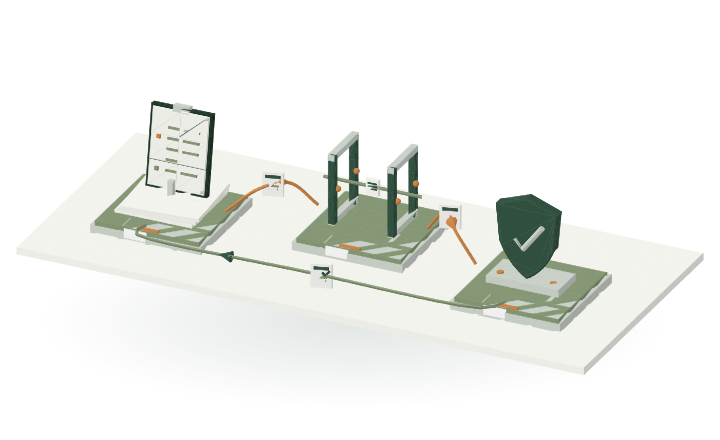
01
An approved partner contract defines data scope, version, mapping and responsibility.
02
Data is sent or received with versioning through the agreed adapter.
03
Acknowledgements and errors remain visible; retries prevent duplicate professional posting.
View the domain workflow in 3D +
M17 / WORKFLOWStep by step
Agreed data packageBeing transferred
Illustrative workflow model
01Contract & mapping
→
INFORMATIONAgreed data package
→
02Transfer with versioning
Data scope · Mapping · VersionReady for handover
An approved partner contract defines data scope, version, mapping and responsibility.
Data is transferred through agreed mappings, acknowledged and retried under control if errors occur.What information is passed on?
01 → 02
Agreed data package
Data scope · Mapping · Version
02 → 03
Transmission & acknowledgement
Partner · Acceptance · Status
03 → 01
Check & retry status
Error · Correction · Idempotency
DATA EXCHANGE / MODULE CONNECTIONS
Interfaces in context.
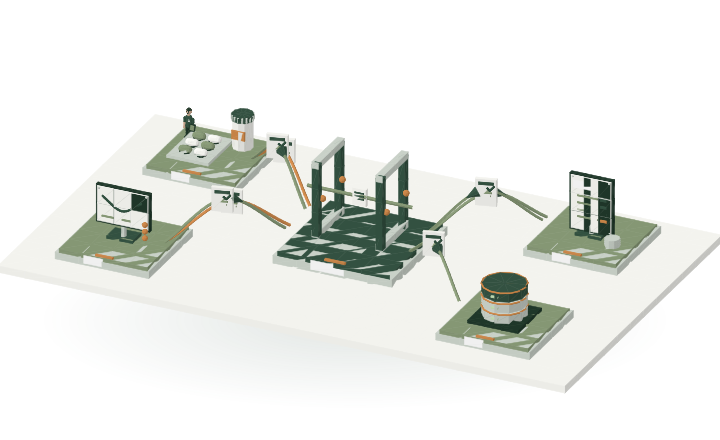
M17 is at the centre. The connections show which modules can provide or receive information when they have been selected and configured for your institution. Select a connection to view the data it covers.
M17 / CONNECTIONSExchange across modules
Medical responseBeing transferred
Versioned module contracts
M17This module
→
INFORMATIONMedical response
→
M03Medical exchange
Approved prescription and medication data.Ready for handover
Approved prescription and medication data. The FHIR profile, version and partner contract are defined for each connection.
The connections show domain data relationships. Specific API contracts and partner connections are versioned and approved separately.
Mapping version, acknowledgement, errors and retries.
Professional rule
A retry must not create a second domain posting.
The module requirements define the exchange of domain information. Each module manages its own data; other modules use approved, versioned contracts. Permissions, tenant, revision and acknowledgement are preserved throughout.
i
External partners and professional standards
Invoice formats from Forum Datenaustausch, SHIP, HIN, EPD and FHIR profiles serve different purposes. A production connection requires its own partner contract, agreed mapping and acceptance. Finance and payroll systems are connected through their approved export contracts.
M17 / EXTERNAL SYSTEMS
Beyond the system boundary.
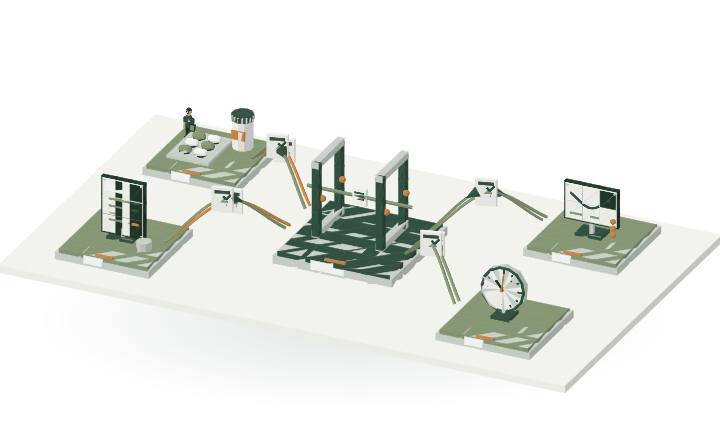
M17 brings together exchange with commissioned third-party systems. Data scope, professional standard and transport are defined separately for each connection. The arrows show transmission and response.
M17 / PARTNERSExternal system boundaries
Prescription & orderBeing transferred
Partner contract · Mapping · Acknowledgement
M17This module
→
INFORMATIONPrescription & order
→
MEDMedical partners
Approved prescriptions, orders and medical responses.Ready for handover
Approved prescriptions, orders and medical responses. The FHIR profile and version are agreed per partner. Medicine master data requires a separate licensed source.
The illustration shows connection groups. Every production partner connection receives its own contract, mapping and acceptance review.
Medical practice, pharmacy & medical partnersMED ↔ M17
Data scope
Approved prescriptions, orders and medical responses.
Contract & rule
The FHIR profile and version are agreed per partner. Medicine master data requires a separate licensed source.
HIN communication & EPDDOK ↔ M17
Data scope
Approved documents, delivery and external responses.
Contract & rule
HIN delivery and EPD document exchange are separate connections with their own partner contracts and approvals.
Funding bodies & invoice transmissionKTR ↔ M17
Data scope
Invoices, funding authorisations, acknowledgements and rejections.
Contract & rule
Professional formats from Forum Datenaustausch, transmission partners and SHIP processes are agreed separately.
Financial accounting & appointed payroll systemERP ↔ M17
Data scope
Approved services, financial data, actual time and associated responses.
Contract & rule
Versioned export contracts, repeatability and reconciliation prevent duplicate processing. Payroll reporting remains with the appointed payroll system.
This module, selectable according to need, is part of Oronela in finalisation. Functions, responsibilities and interfaces form the fixed scope. Finalisation combines professional acceptance reviews with feedback from care institutions: real needs determine the final improvements.
Cross-checked against the module requirements, implementation specification and current Oronela system codebase: 1 October 2026. Product requirements M17-01–M17-04 · M17-A–F. The following areas are explained on this page: