The 18 modules form the feature catalogue; they are not a mandatory selection. You decide which areas your institution uses. AI is activated only on request. Clinical dependencies and finalisation are described on the module pages.
01 / IN DAILY USE
Tasks and responsibility.
You choose this module according to your institution's needs. The interfaces described are configured for the areas you select. AI support is available exclusively on request and processes data on Oronela's own servers in Switzerland.
The care record connects needs, goals, interventions and actual care. An approved care plan describes what is intended; observations and delivery records describe what happened. Both layers remain connected without presenting scheduled care as already delivered.
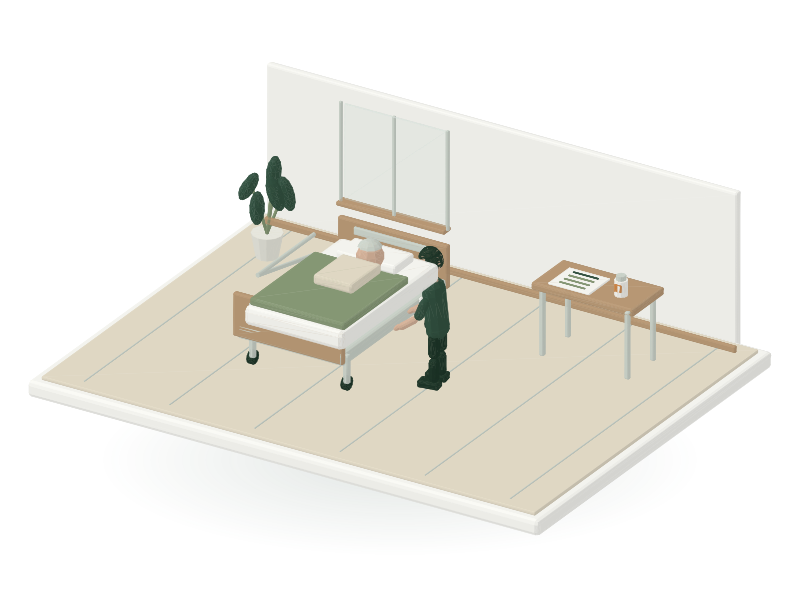
At the bedside, a short, clear process matters. Resident context, measurement time, unit and the person carrying out the action remain visible. A report entered later shows both the actual time and the time of entry. The shift handover uses this to carry forward outstanding tasks and important changes, along with the exact data version seen.
Information maintained by the module
Area
Content and meaning
Care plan revision
Need, goal, intervention, frequency, competence, validity and next evaluation.
Observation and care delivery
Measurement, unit, method, source, actual care delivered, and the person carrying out and documenting the action.
Signed entry and addendum
The unchanged original with a separate, reasoned addition or correction; the original approval is preserved.
02 / MODULE FUNCTIONAL SCOPE
What this module covers.
3 functional areas connect this module's tasks. The following sections explain their content, processing and responsibilities.
01
Versioned care plan and evaluation
Combine care needs, goals and recurring interventions into a traceable plan and automatically prepare evaluations as they become due.
Record care needs, goals, interventions, frequency, period, responsible competence and evaluation criteria in structured form; each approved version remains immutable.
Distinguish between a draft plan, the clinically confirmed active revision, a superseded revision and an ended intervention. Intended validity is not the same as the time of entry.
Changes must specifically invalidate affected future care delivery instructions. Past delivery permanently references the plan revision valid at the time.
Derive evaluation deadlines, open queries and delegable activities with assigned responsibility. Missing information about needs is unknown, not a denial.
Plan changes with clinical significance require a current competence and relationship check and explicit approval; templates are versioned and never silently copy resident values.
Responsibility
Qualified care professionals plan and confirm within their competence; assistants record proposals or assigned data; management sees outstanding evaluations and escalates them.
Automation & AI
AI suggests wording, goals and summaries from approved sources; it has no independent write or approval right. Confirmation binds the input, knowledge, prompt and plan revisions. AI features require activation at your request. Processing remains on Oronela's own servers in Switzerland.
Connection & offline use
Read the approved, assigned plan with an indication of its currency and draft changes locally; binding clinical approval of the plan is online only.
02
Observations, care delivery and signed addenda
Document safely at the bedside, avoid repetition and clearly distinguish actual care from drafts, plans and later retrospective entries.
Record vital signs with unit, measurement method, time and source, pain, wounds with approved images and care incidents in a structured format plus free text; version limits and justified clinical exceptions.
Every care delivery entry names the actual time, person carrying out the care, documenting actor, plan revision and any deviation. An entry confirms only services actually delivered.
Switching residents invalidates open entry contexts that affect safety; attachments, dictation and measurements must be assigned to the visibly confirmed person.
Never overwrite signed entries: additions or corrections include a reason, author, reference to the original and their own approval. Explicitly record the meaning of the signature and the signed data revision.
Drafts produced through speech input or AI retain the original input where permitted, the result, source version and review decision. Simply accepting an autocomplete suggestion does not constitute approval.
Photos and attachments use only a protected object port with permissions, metadata checks and content checks; no private device gallery or automatic unprotected backup.
Responsibility
Qualified nursing staff record and sign within their area of competence; assistants carry out delegated actions; wound and image access is controlled separately. The person documenting and the person who actually performed the action must never be silently treated as the same person.
Automation & AI
Local dictation and writing assistance produce explicitly reviewable drafts. Negations, similar doses and units, incorrect resident references and invented observations are separate evaluation case categories; clinical confirmation remains human. AI features require activation at your request. Processing remains on Oronela's own servers in Switzerland.
Connection & offline use
Observations and reports are encrypted local drafts within the lease; a local journal is written before confirmation. The server rechecks permissions and revisions; clinical signatures and binding plan changes require an online connection. Medication administration belongs exclusively to M03-C.
03
Shift handover, delegation and outstanding care tasks
Reliably hand over outstanding, time-critical work at shift changes and avoid duplicate queries through a shared current task view.
The handover brings together permitted resident updates, open tasks, queries and time-critical deviations; the data status and revisions used are visible.
Each task has a responsible person or role, substitute, due date, acknowledgement and escalation. The end of a shift must not remove responsibility.
Delegation requires valid competence and named supervision where clinically necessary; accepting a delegation and actually completing it are different actions.
Handover confirmation binds the version seen. New critical incidents after preparation mark the summary as outdated and require acknowledgement.
Views and exports remain limited to the unit and resident; team membership alone does not grant access to all records. Bulk actions must never confirm care that was not delivered.
Responsibility
Outgoing and incoming nursing staff, delegated staff and unit management work within active assignments; escalation permissions are separate from clinical handling.
Automation & AI
AI summarises confirmed changes with evidence links and flags uncertainty. It must not remove outstanding tasks from the list, decide competence or acknowledge a handover; a complete deterministic list is shown alongside it. AI features require activation at your request. Processing remains on Oronela's own servers in Switzerland.
Connection & offline use
Read assigned tasks and provisionally record non-critical notes; accepting a handover, new delegation and changes to deadlines or responsibility require an online connection. An offline view does not promise a current transfer of responsibility.
03 / PRACTICAL EXAMPLE
From observation to the next shift
01
A staff member documents an actual observation within the confirmed resident context.
02
The responsible care professional reviews the entry and decides whether the plan needs to change.
03
The new plan revision updates future tasks; earlier care delivery retains its original basis.
04
The next shift explicitly accepts the open task and can see changes made since the handover was prepared.
Observation, professional decision and delivery remain connected as separate records. Reading a message or accepting AI wording does not complete a care task.
SYSTEM WORKFLOW / Typical workflow
Typical workflow
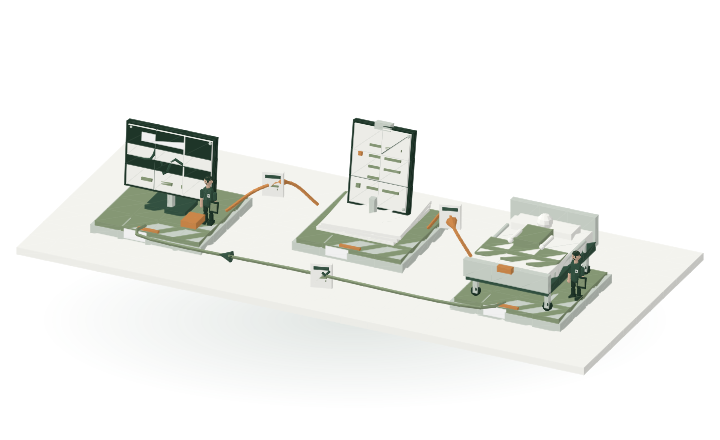
01
Observations and vital signs are documented with time, source and resident reference.
02
The care professional assesses the need and confirms the valid plan revision.
03
The team documents the care actually delivered; outstanding items return to the handover with assigned responsibility.
View the domain workflow in 3D +
M02 / WORKFLOWCare · Resident
Care observationBeing transferred
Illustrative workflow model
01Observe
→
INFORMATIONCare observation
→
02Confirm care plan
Vital sign · Time · SourceReady for handover
Observations and vital signs are documented with time, source and resident reference.
Observation, planning, care delivery and handover remain connected.What information is passed on?
01 → 02
Care observation
Vital sign · Time · Source
02 → 03
Confirmed care plan
Intervention · Responsibility · Due date
03 → 01
Shift handover
Delivery · Outstanding points · Addendum
DATA EXCHANGE / MODULE CONNECTIONS
Interfaces in context.
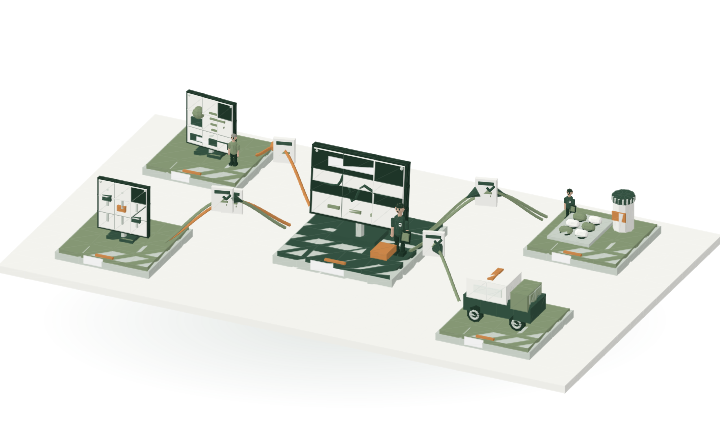
M02 is at the centre. The connections show which modules can provide or receive information when they have been selected and configured for your institution. Select a connection to view the data it covers.
M02 / CONNECTIONSExchange across modules
Resident profileBeing transferred
Versioned module contracts
M01Resident identity
→
INFORMATIONResident profile
→
M02This module
Identity, stay and approved context.Ready for handover
Identity, stay and approved context. Identity remains recognisable before every action that affects safety.
The connections show domain data relationships. Specific API contracts and partner connections are versioned and approved separately.
Outstanding interventions, responsibility and due date.
Professional rule
Completion and professional evidence of services remain distinguishable.
The module requirements define the exchange of domain information. Each module manages its own data; other modules use approved, versioned contracts. Permissions, tenant, revision and acknowledgement are preserved throughout.
This module, selectable according to need, is part of Oronela in finalisation. Functions, responsibilities and interfaces form the fixed scope. Finalisation combines professional acceptance reviews with feedback from care institutions: real needs determine the final improvements.
Cross-checked against the module requirements, implementation specification and current Oronela system codebase: 1 October 2026. Product requirements M02-01–M02-05 · M02-A–C. The following areas are explained on this page: