Appointments are linked to accompaniment, transport, preparation and reliable tasks.
An appointment receives the appropriate tasks for accompaniment and transport. The team can see who is responsible and what has already been completed.
The 18 modules form the feature catalogue; they are not a mandatory selection. You decide which areas your institution uses. AI is activated only on request. Clinical dependencies and finalisation are described on the module pages.
01 / IN DAILY USE
Tasks and responsibility.
You choose this module according to your institution's needs. The interfaces described are configured for the areas you select. AI support is available exclusively on request and processes data on Oronela's own servers in Switzerland.
Appointments are managed as a coordinated workflow with preparation, accompaniment, transport and documents. Internal tasks and external booking statuses remain connected. Employees can see what is confirmed, which resources are missing and who must handle an outstanding query.
A change can affect several teams: a postponed doctor's appointment may change the journey, accompaniment, reminder and catering. The module tracks these downstream changes with their respective confirmation status. Clinical preparation is taken from the responsible order, not inferred from the appointment type or time.
Information maintained by the module
Area
Content and meaning
Appointment and booking request
Person, location, time, participants, external source, resources and requested or confirmed status.
Task
Source, prerequisite, competence, responsibility, representation, due date and evidenced completion criterion.
Preparation plan
Confirmed order and related tasks with revision, valid time window and outstanding changes required.
02 / MODULE FUNCTIONAL SCOPE
What this module covers.
3 functional areas connect this module's tasks. The following sections explain their content, processing and responsibilities.
01
Appointments, resources and external booking statuses
Record an appointment once and track transport, accompaniment, documents and external confirmation directly against it.
Link appointments to the resident, participants, location, location time zone, duration, accompaniment, transport, preparation and approved documents; manage external organisations and contact channels separately from internal people.
Show requested, confirmed, postponed, cancelled and unclear separately. Sending or technically receiving a request is not professional confirmation of an appointment.
Check conflicts involving residents, staff, rooms and vehicles. For each item, it must be visible which resources are firmly reserved and which have only been requested.
Assign external responses with their source, time and reference. Free-text or telephone responses require authorised confirmation of the structured values.
Explicitly model time zones, daylight-saving changes, half-open intervals and changes to recurring appointments; a single exception must not silently change the entire series.
Calendar exports and participant views minimise resident data; no health content appears in publicly accessible calendar links or unprotected emails.
Responsibility
Appointment administration and assigned care staff plan; employees confirm their own accompaniment within their competence; external parties receive narrowly limited booking information.
Automation & AI
AI converts telephone or document notes into appointment drafts and formulates booking requests. Confirmed time, location and preparation require a verified source; nothing is invented when a response is missing. AI features require activation at your request. Processing remains on Oronela's own servers in Switzerland.
Connection & offline use
Read assigned appointments with their data status and record a request draft locally; external booking confirmation and binding resource reservations take place online.
02
Tasks, acknowledgement and escalation
Automate recurring coordination and ensure every outstanding task has a responsible person and verifiable completion.
Maintain tasks with source, dependencies, due date, priority, responsible person or role, representative, required competence and completion criterion.
Distinguish created, assigned, offered, accepted, started, blocked, professionally completed and cancelled. A push or read receipt is neither acceptance nor completion.
Check the dependency graph for cycles and make unmet prerequisites visible. Critical tasks must not receive an unsecured automatic completion.
Version server-side deadlines, recurrence and escalation chains; do not depend on a browser remaining open or guaranteed mobile push delivery.
An automatically created task has a stable professional deduplication reference from its source, revision and task type. A new source can invalidate it but cannot delete a service already documented.
Acknowledgement and execution must check current permissions, competence and source revision; changes of substitute require a traceable handover.
Responsibility
Task creators act only within their own domain; responsible people accept permitted tasks; management maintains escalation chains within its authority.
Automation & AI
AI structures draft tasks, groups outstanding queries and suggests responsibilities. It must not bypass deadlines or competencies or infer completion from a message. AI features require activation at your request. Processing remains on Oronela's own servers in Switzerland.
Connection & offline use
Non-critical evidence can be recorded provisionally locally; binding assignment, delegation, critical completion and deadline changes require an online connection. Synchronisation checks current permissions and professional status and preserves necessary clarification evidence.
03
Confirmed preparation and coordinated appointment changes
Coordinate medical appointments, clinical preparation, transport, accompaniment and catering from confirmed information, and update them reliably when changes occur.
Use fasting and other clinical preparation requirements only from a confirmed order revision with its source, validity window, exceptions and responsible professional.
A morning appointment, an assumed examination type or AI output does not justify a restriction. An unclear free-text instruction creates a query and an unresolved status.
The workflow revision binds the appointment, order, transport, accompaniment, documents and catering request. Dependent orders receive the source revision and a stable idempotency reference.
Rescheduling or cancelling an appointment, or a new order, invalidates affected open tasks and requests any necessary reconfirmation. A journey, meal handover or communication already completed remains a recorded fact and generates the required correction task.
The permitted consumption time may come only from a confirmed source; pending approval after an examination is passed on as pending, not calculated from the appointment end.
Changes across modules are managed as a monitored sequence of states with retries and clarification cases; no distributed all-or-nothing transaction is claimed. A downstream change not yet confirmed remains visible.
Responsibility
Appointment planning coordinates; clinically authorised doctors and care staff confirm orders; the kitchen confirms its orders; accompaniment staff acknowledge handovers and professionally permitted tasks. No one takes over another person's clinical approval.
Automation & AI
AI extracts unclear information as a suggestion and formulates queries, workflow overviews and change summaries. Deterministic rules generate follow-up tasks from approved sources only. AI features require activation at your request. Processing remains on Oronela's own servers in Switzerland.
Connection & offline use
Read the approved workflow view and provisionally record non-critical notes. Accepting orders, permitting consumption and binding appointment or follow-up changes take place online; cached data displays its status and a warning.
03 / PRACTICAL EXAMPLE
A doctor's appointment is postponed at short notice
01
An authorised person confirms the new time from the external response.
02
Transport, accompaniment and open reminders are checked against the updated status.
03
Clinical preparations and meals taken off site are coordinated again using their confirmed sources.
04
The responsible teams acknowledge the affected downstream changes.
A journey or meal handover already completed remains visible as a fact. Outstanding confirmations are shown as needing clarification until the new workflow is actually coordinated.
SYSTEM WORKFLOW / Typical workflow
Typical workflow
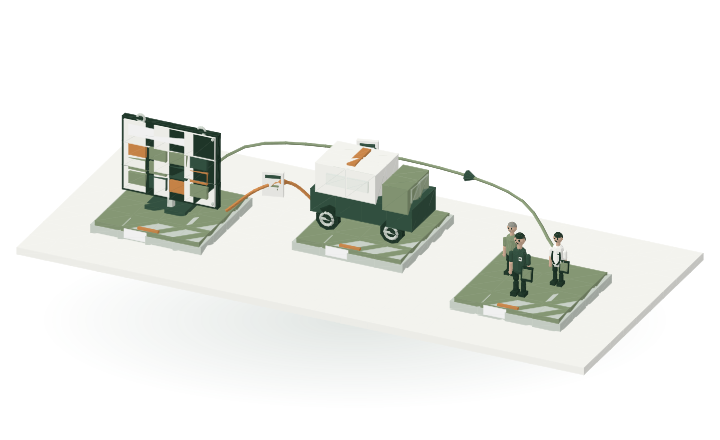
01
An appointment is confirmed with its period, resident and responsible party.
02
The appointment generates its own transport task with assigned responsibility and feedback.
03
Accompaniment and preparation have their own tasks; changes and completion are tracked individually.
View the domain workflow in 3D +
M07 / WORKFLOWResident · Care · Doctor
Transport orderBeing transferred
Illustrative workflow model
01Confirm appointment
→
INFORMATIONTransport order
→
02Coordinate transport
Appointment · Destination · ResponsibilityReady for handover
An appointment is confirmed with its period, resident and responsible party.
An appointment branches into follow-up tasks with assigned responsibility for transport and accompaniment.What information is passed on?
01 → 02
Transport order
Appointment · Destination · Responsibility
01 → 03
Accompaniment task
Preparation · Person · Due date
DATA EXCHANGE / MODULE CONNECTIONS
Interfaces in context.
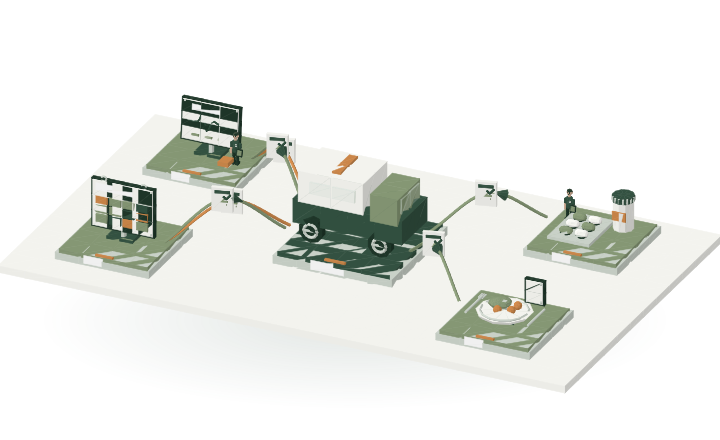
M07 is at the centre. The connections show which modules can provide or receive information when selected and configured for your institution. Choose a connection to see its data scope.
M07 / CONNECTIONSExchange across modules
Preparation taskBeing transferred
Versioned module contracts
M07This module
→
INFORMATIONPreparation task
→
M02Care task
Preparation, responsible person and actual completion.Ready for handover
Preparation, responsible person and actual completion. Professional preparation is confirmed by the responsible person.
The connections show domain data relationships. Specific API contracts and partner connections are versioned and approved separately.
The module requirements define the exchange of domain information. Each module manages its own data; other modules use approved, versioned contracts. Permissions, tenant, revision and acknowledgement are preserved throughout.
This module, selectable according to need, is part of Oronela in finalisation. Functions, responsibilities and interfaces form the fixed scope. Finalisation combines professional acceptance reviews with feedback from care institutions: real needs determine the final improvements.
Comparison with the module requirements, implementation plan and current Oronela system codebase: 1 October 2026. Product requirements M07-01–M07-05 · M07-A–C. The following areas are explained on this page: