The 18 modules form the feature catalogue; they are not a mandatory selection. You decide which areas your institution uses. AI is activated only on request. Clinical dependencies and finalisation are described on the module pages.
01 / IN DAILY USE
Tasks and responsibility.
You choose this module according to your institution's needs. The interfaces described are configured for the areas you select. AI support is available exclusively on request and processes data on Oronela's own servers in Switzerland.
Assessments make structured evaluations and their development comparable. The module brings together the instrument, specific edition, approved language, inputs and calculation rules. The instruments an institution uses are determined by its professional requirements and the necessary usage rights.
A score is only as meaningful as its confirmed inputs and rules. Missing answers, non-applicable questions and invalid values are therefore explicitly distinguished. Progress views show measurement time, sources and data gaps. Clinically approved alerts are assigned responsible handling and do not replace an independent diagnosis.
Information maintained by the module
Area
Content and meaning
Instrument revision
Questions, answer codes, branching, purpose, licence, language and approved scope of validity.
Assessment and score
Confirmed answer revisions, rule version, units, calculation time and traceable result.
Alert and follow-up
Trigger, source, priority, responsible person, deadline, acknowledgement and professional handling.
02 / MODULE FUNCTIONAL SCOPE
What this module covers.
3 functional areas connect this module's tasks. The following sections explain their content, processing and responsibilities.
01
Versioned assessment instruments and data entry
Guide users clearly through approved assessments and reduce duplicate entries by reusing existing values in a traceable way.
Register instruments with their specific version, question and answer schema, intended purpose, usage rights, language, validity and permitted competences.
Questions and answer options have language-independent codes; translations are clinically authorised for each instrument revision. Unrestricted AI translation must not silently replace a validated question.
Draft assessments bind the resident and instrument revision. Imported measurements show source, time and confirmation; old data is not presented as newly collected current data.
Distinguish unknown, not collected, not applicable and answered. Mandatory fields and branching depend on the instrument and are versioned.
A published instrument remains immutable; a new version requires new approval and does not apply retrospectively to completed assessments.
Responsibility
Clinical owners approve instruments and translations; care and therapy staff authorised to use them record entries; administrative licence management does not confer clinical approval rights.
Automation & AI
AI finds existing sources and suggests draft answers with evidence. Actual observation, answer and approval remain with the professional; mandatory questions are not answered by assumption. AI features require activation at your request. Processing remains on Oronela's own servers in Switzerland.
Connection & offline use
Draft assigned assessments locally; the valid offline lease, source status and question version remain visible. Final professional confirmation is online and checked against current permissions.
02
Deterministic scores and source histories
Automatically produce reproducible calculations and understandable histories so professionals can investigate causes instead of transferring figures.
Version calculation rules, rounding, units and handling of missing values; only confirmed inputs produce an approved score.
Do not interpret a missing answer as zero, normal or unremarkable. Invalid, incomplete and not calculable are results in their own right.
Each score stores the instrument and rule version, confirmed input revisions, calculation time and exact result; a new rule version does not change old results.
Histories, care needs and quality indicators show their source, measurement time, data gaps and comparability across instrument versions. Aggregation must not silently mix heterogeneous units.
Derive review deadlines from approved rules and pass on responsibility; report projections must use the same metric definition and data version.
Responsibility
Professionals see progress histories based on relationships or wards; professional rule owners approve calculations; quality management and reporting receive purpose-appropriate aggregates and authorised drill-downs.
Automation & AI
AI explains differences in everyday language with source links and uncertainties; it does not calculate its own scores or reinterpret missing values. The verified numerical function remains available without a GPU. AI features require activation at your request. Processing remains on Oronela's own servers in Switzerland.
Connection & offline use
Read confirmed local results only with their data status and draft new assessments locally. Binding calculation, approval and deadline changes take place online; no offline value is presented as a fresh server score.
03
Approved risk alerts and follow-up
Deliver clinically approved alerts to the responsible people in good time and limit alert fatigue through clear priority, reasoning and acknowledgement.
For each risk function, document and confirm the specific intended purpose, regulatory classification, input quality, thresholds, recipients and required response before production approval.
Configure alarm thresholds and rules with versioning; unverified AI risk values must trigger neither a validated label nor an autonomous clinical instruction.
Alerts identify the specific triggering values, time, sources and rule version. Missing data or outdated calculations may generate their own professionally approved clarification alert, never a blanket all-clear.
Distinguish acknowledged, clinically addressed, dismissed with a reason and escalated. Deduplicate repeats and record necessary changes or all-clear notices with reference to the previous case.
Server-side deadlines and fallback recipients work independently of push notifications or AI. Suppression is time-limited and restricted to approved clinical rules.
Responsibility
Clinical leads approve rules; assigned competent staff handle cases; management handles defined escalations. System administrators may not activate clinical thresholds on their own authority.
Automation & AI
AI produces explanations supported by sources and drafts queries. It changes neither alarm thresholds, priority nor status; human and deterministic handling remains complete without AI. AI features require activation at your request. Processing remains on Oronela's own servers in Switzerland.
Connection & offline use
Only previously approved alerts are visible locally, with their freshness status. New acknowledgements and clinical completion require an online connection; a note recorded offline does not confirm that an alert response has been completed.
03 / PRACTICAL EXAMPLE
Repeated assessment with a missing value
01
The professional opens the valid instrument revision for the resident.
02
Existing values can be reused with their visible source and confirmed for the new assessment.
03
A missing answer is explicitly shown as not collected.
04
The progress view shows whether a result can be calculated and compared with earlier assessments.
The result does not receive an artificial zero or an all-clear. A new instrument version does not retrospectively change older completed assessments.
SYSTEM WORKFLOW / Typical workflow
Typical workflow
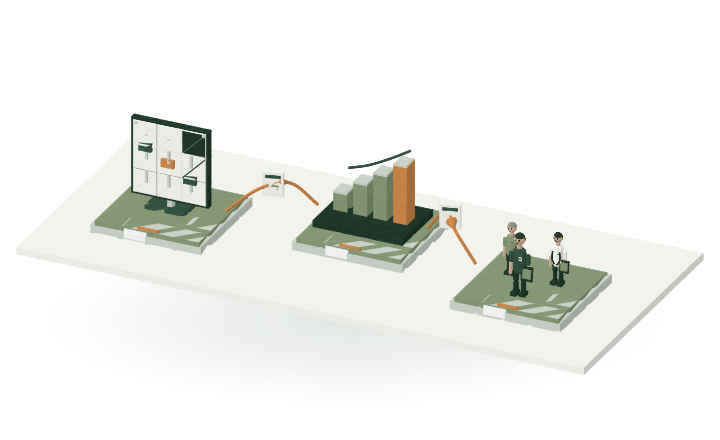
01
Inputs are confirmed with their source and period; missing values remain recognisable.
02
The valid instrument and rule version calculates a traceable score.
03
An authorised professional evaluates the result and progress in the resident context.
View the domain workflow in 3D +
M04 / WORKFLOWResident · Care · Doctor
Confirmed findingsBeing transferred
Illustrative workflow model
01Confirm information
→
INFORMATIONConfirmed findings
→
02Calculate a score
Value · Period · Instrument versionReady for handover
Inputs are confirmed with their source and period; missing values remain recognisable.
Confirmed values are converted into a progress history that can be assessed using valid instrument rules.What information is passed on?
01 → 02
Confirmed findings
Value · Period · Instrument version
02 → 03
Assessment result
Score · History · Data provenance
DATA EXCHANGE / MODULE CONNECTIONS
Interfaces in context.
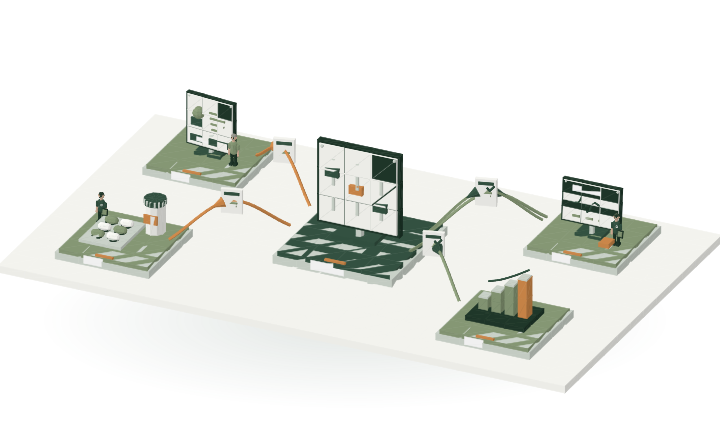
M04 is at the centre. The connections show which modules can provide or receive information when they have been selected and configured for your institution. Select a connection to view the data it covers.
M04 / CONNECTIONSExchange across modules
Resident contextBeing transferred
Versioned module contracts
M01Resident context
→
INFORMATIONResident context
→
M04This module
Identity and stay for the specific finding.Ready for handover
Identity and stay for the specific finding. Only the authorised resident area is visible.
The connections show domain data relationships. Specific API contracts and partner connections are versioned and approved separately.
Assessed results with source, period and instrument version.
Professional rule
Details and exports remain subject to the original permissions.
The module requirements define the exchange of domain information. Each module manages its own data; other modules use approved, versioned contracts. Permissions, tenant, revision and acknowledgement are preserved throughout.
This module, selectable according to need, is part of Oronela in finalisation. Functions, responsibilities and interfaces form the fixed scope. Finalisation combines professional acceptance reviews with feedback from care institutions: real needs determine the final improvements.
Comparison with the module requirements, implementation plan and current Oronela system codebase: 1 October 2026. Product requirements M04-01–M04-04 · M04-A–C. The following areas are explained on this page: