The 18 modules form the feature catalogue; they are not a mandatory selection. You decide which areas your institution uses. AI is activated only on request. Clinical dependencies and finalisation are described on the module pages.
01 / IN DAILY USE
Tasks and responsibility.
You choose this module according to your institution's needs. The interfaces described are configured for the areas you select. AI support is available exclusively on request and processes data on Oronela's own servers in Switzerland.
Resident administration provides the shared foundation for care, daily life and billing. A person is registered with a verified identity; contacts, representatives, preferences and periods of stay are linked to it. Different teams can thus use the same confirmed foundation without each maintaining separate resident master data.
An admission involves several decisions: checking identity and representation, confirming a suitable place, completing documents and organising clinical handovers. The module makes outstanding points and responsibilities visible. A hospital absence, return or transfer changes the stay while preserving the person's previous history.
Information maintained by the module
Area
Content and meaning
Resident profile
Identity, verified identifiers, biography, preferred communication language and personal information for defined purposes.
Contact and representation
Relationship, scope of authority, evidence, validity and revocation; a contact person is not automatically authorised to sign.
Period of stay
Admission, transfer, absence, return and discharge with event time, source and responsible person.
02 / MODULE FUNCTIONAL SCOPE
What this module covers.
3 functional areas connect this module's tasks. The following sections explain their content, processing and responsibilities.
01
Identity, contacts, representatives and resident profile
Capture a verified resident record once and reuse approved information for defined purposes; reduce duplicate entry and confusion between people.
Maintain resident identity, external identifiers including issuer, contacts, funding bodies, consent and representation authority with validity interval and revision. Changes must not overwrite historical states or permissions that applied at the time.
Identity registration distinguishes verified, unverified and incomplete information; a name or date of birth alone does not establish an identity. Resident numbers are display attributes, not technical keys.
Record life history, preferred communication language, communication aids, personal preferences and explicitly expressed wishes in structured form with supplementary free text; their source and approved purpose must be established.
Provide projections of individual fields for care, the kitchen, support and administration. Resident language and user language are separate attributes; a resident profile never changes the logged-in person's UI language.
Manage representation with scope, evidence, start, end and possible revocation effect. Every use checks the current legal basis; historical evidence remains available.
Responsibility
Resident administration manages master data; nursing staff verify professionally permitted information; data protection and representation checks have clearly bounded actions; the kitchen reads only nutrition and assignment information. Technical administrators have no blanket editing authority.
Automation & AI
Local AI may convert scanned documents into a draft with evidenced provenance and flag missing information. Identity checks, representation, consent and conflict resolution remain confirmed by people; the full manual workflow is available. AI features require activation at your request. Processing remains on Oronela's own servers in Switzerland.
Connection & offline use
Only the minimum approved resident dataset can be read within a valid offline lease; local drafts of master data are possible. Identity checks, activation of consent or representation and current access approval require an online connection.
02
Stay, admission, transfer and discharge
Carry out admissions and state changes as guided workflows with reused data, clear responsibility and traceable downstream tasks.
Record admission, internal transfer, hospital absence, return, discharge and death with the event time, source, responsible person and a correction procedure requiring reasons.
Admission and transfer use a confirmed bed reservation from M05. A multistep workflow distinguishes requested, confirmed, failed and clarification required; partial failures create neither incorrect occupancy nor lost responsibility.
An absence does not end an identity; periods of stay remain traceable over time. A return must not automatically reauthorise previous medication and clinical plans.
Checklists for documents, reconciliation, aids and information are configurable, versioned and identify responsible roles. Administrative completeness must not imply clinical approval.
Discharge or death triggers cancellation of scheduled operational services through versioned events; services already delivered are not deleted. An incorrect status change has a defined correction path.
Responsibility
Administration performs operational admission and discharge; nursing staff and doctors confirm only their clinical handovers; unit management is responsible for transfers. Clinical competence is checked for each action.
Automation & AI
AI summarises admission documents and outstanding points and creates draft tasks. It does not confirm a stay, death, medication reconciliation or legal status. AI features require activation at your request. Processing remains on Oronela's own servers in Switzerland.
Connection & offline use
Preparation as a local draft is permitted; binding admission, transfer, return, discharge and dependent approvals require an online connection. Unsynchronised entries are visibly separate from the effective stay status.
03
Duplicate detection and controlled merging
Identify duplicate registrations early and resolve them with a second-person check, without losing medical provenance or previous identities.
Candidate comparisons show explainable matches and differences; similar names create only a review case. Rules and thresholds are versioned.
Merging requires specific verified source and target identities, different qualified reviewers and approval of the exact revisions compared.
Source identities remain as resolvable alias and provenance references. Module references are handled through a versioned identity resolution port; there are no unchecked table updates in other modules.
Conflicting consents, representations, allergies, stays or prescriptions are flagged as domain conflicts. Merging does not grant additional consent and does not automatically adopt the interpretation posing the greatest risk.
Correcting an incorrect merge supports a documented clarification and separation process with impact analysis; signed historical entries remain unchanged and show their original assignment.
Responsibility
Trained resident administration staff perform the check; an independent second authorised person confirms it; clinical staff resolve clinical discrepancies. The person proposing the change may not give both approvals.
Automation & AI
AI may explain candidates and differences, works only with authorised data and logs sources. Every merge and correction remains a controlled human decision. AI features require activation at your request. Processing remains on Oronela's own servers in Switzerland.
Connection & offline use
A candidate note may be drafted locally; comparison against current data, approval, merging and correction are online only.
03 / PRACTICAL EXAMPLE
Returning after a hospital stay
01
Administration confirms the return and the existing stay.
02
Occupancy and affected follow-up tasks are reconciled with the current sources.
03
Nursing staff and medical professionals review the documents brought in and medication reconciliation.
04
The kitchen and support staff receive only the information needed to resume daily life.
The person remains the same, while the stay, responsibility and clinical approvals each have their own current state. Returning does not automatically make old prescriptions executable again.
SYSTEM WORKFLOW / Typical workflow
Typical workflow
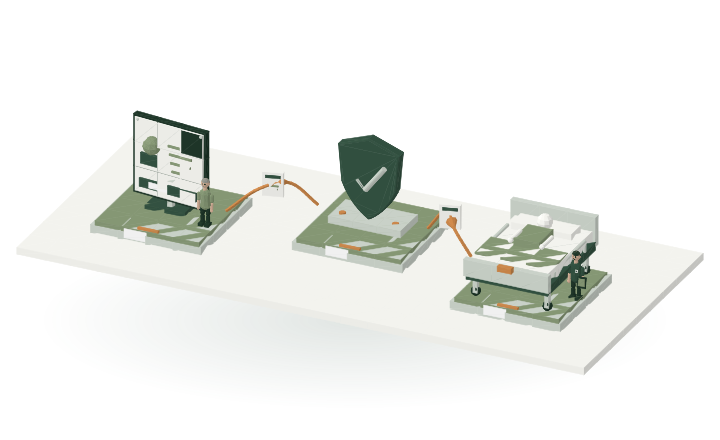
01
Identity, representation and relevant master data are assigned to the resident.
02
Consent and admission prerequisites are checked in the valid context.
03
An approved place becomes a time-managed stay covering admission, transfer and discharge.
View the domain workflow in 3D +
M01 / WORKFLOWResident · Care
Resident profileBeing transferred
Illustrative workflow model
01Record identity
→
INFORMATIONResident profile
→
02Check consent
Identity · Representation · AdmissionReady for handover
Identity, representation and relevant master data are assigned to the resident.
Identity, consent and a place form one admission process.What information is passed on?
01 → 02
Resident profile
Identity · Representation · Admission
02 → 03
Admission approval
Consent · Place · Period
DATA EXCHANGE / MODULE CONNECTIONS
Interfaces in context.
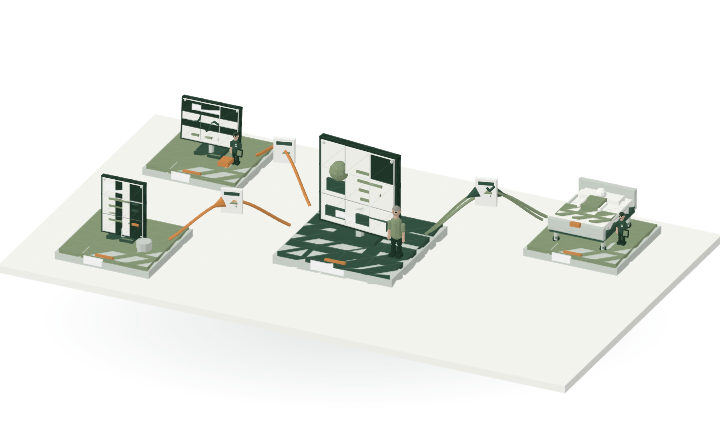
M01 is at the centre. The connections show which modules can provide or receive information when they have been selected and configured for your institution. Select a connection to view the data it covers.
M01 / CONNECTIONSExchange across modules
Resident contextBeing transferred
Versioned module contracts
M01This module
→
INFORMATIONResident context
→
M02Resident context
Identity, stay and valid consent.Ready for handover
Identity, stay and valid consents. Care uses the approved resident context.
The connections show domain data relationships. Specific API contracts and partner connections are versioned and approved separately.
Period of stay, representation and administrative assignment.
Professional rule
Tariffs and invoices remain in M11.
The module requirements define the exchange of domain information. Each module manages its own data; other modules use approved, versioned contracts. Permissions, tenant, revision and acknowledgement are preserved throughout.
This module, selectable according to need, is part of Oronela in finalisation. Functions, responsibilities and interfaces form the fixed scope. Finalisation combines professional acceptance reviews with feedback from care institutions: real needs determine the final improvements.
Comparison with the module requirements, implementation plan and current Oronela system codebase: 1 October 2026. Product requirements M01-01–M01-04 · M01-A–C. The following areas are explained on this page: